Working in teams requires constant adaptation to an increasingly complex and diverse working environment. Multigenerational teams, neurodiversity, and employees with different experiences, needs, and ways of working are changing how we collaborate, communicate, and organize work. Today, another important element is being added to this diversity: the increasingly widespread use of artificial intelligence (AI) tools. What happens to teamwork when an AI tool becomes a new “colleague”?
A recent Belbin Team Roles study, conducted among 250 professionals in human resources, organizational development, and learning, shows that organizations are already actively experimenting with artificial intelligence while simultaneously facing new challenges related to collaboration, responsibilities, and interpersonal relationships.
Task automation and redefining team contributions
The first phase of AI adoption was largely focused on increasing efficiency by speeding up administrative activities, facilitating data processing, and enabling faster content creation. Today, the focus is gradually shifting toward a much more complex question: how should time, responsibilities, and contributions be redistributed within temas?
According to Microsoft's Work Trend Index, AI is increasingly supporting activities such as information analysis, creative thinking, and problem-solving, while the need for human judgment, decision-making, and relationship management continues to grow. The impact of artificial intelligence, therefore, is not, at least for now, the disappearance of teamwork, but rather a change in the nature of team members' contributions.
For organizations, this raises new questions:
- If AI takes over part of the operational workload, where can people create the greatest value?
- How can organizations ensure that responsibilities do not overlap?
- How can they prevent certain contributions from becoming less visible simply because they are harder to measure or automate?
Human contribution becomes a strategic advantage
Paradoxically, the more advanced technology becomes, the more important human capabilities become.
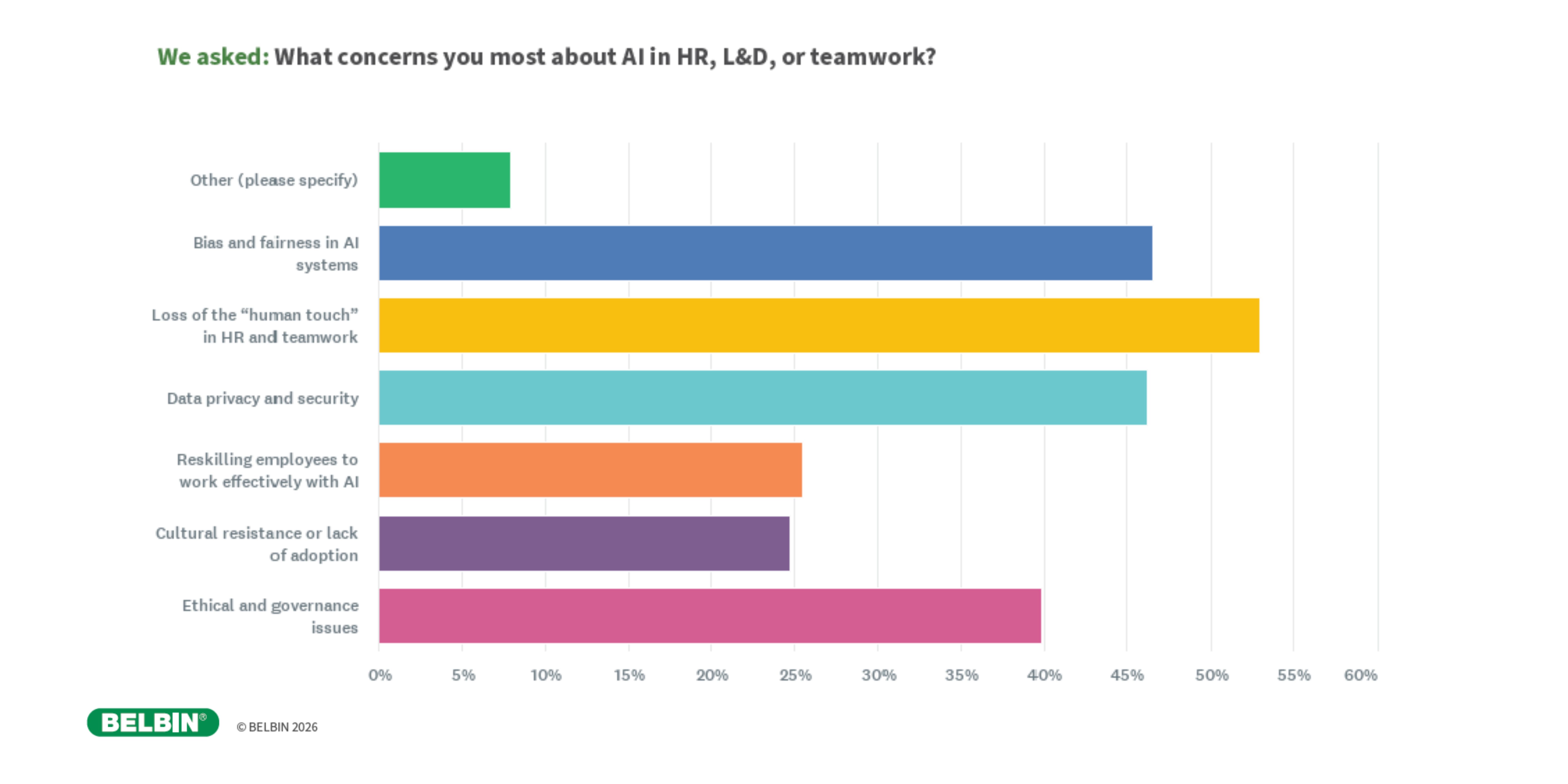
One of the most interesting findings of the Belbin study is that the greatest concern surrounding AI is not a loss of productivity or technological complexity, but the potential loss of the human dimension of collaboration. More than half of respondents identified this as the biggest challenge facing the future of work.
Organizations do not achieve results through processes and technology alone, but through relationships between people. Trust, open communication, effective decision-making, conflict management, and mutual understanding remain essential prerequisites for successful teamwork.
Similar conclusions have been confirmed over the years by Gallup research, which shows that clarity of expectations, the quality of people management, and a sense of individual contribution are among the most important drivers of employee engagement and team performance.
This is precisely why organizations that view AI solely as a technology project risk overlooking its more important dimension: its impact on people and the way they collaborate.
Will AI strengthen or weaken teamwork?
Despite these concerns, the research findings are not pessimistic. Interestingly, respondents in the Belbin study most frequently expect the emergence of new roles and contributions within teams. This suggests that the focus will increasingly shift away from task execution toward how people use their strengths when working alongside AI tools.
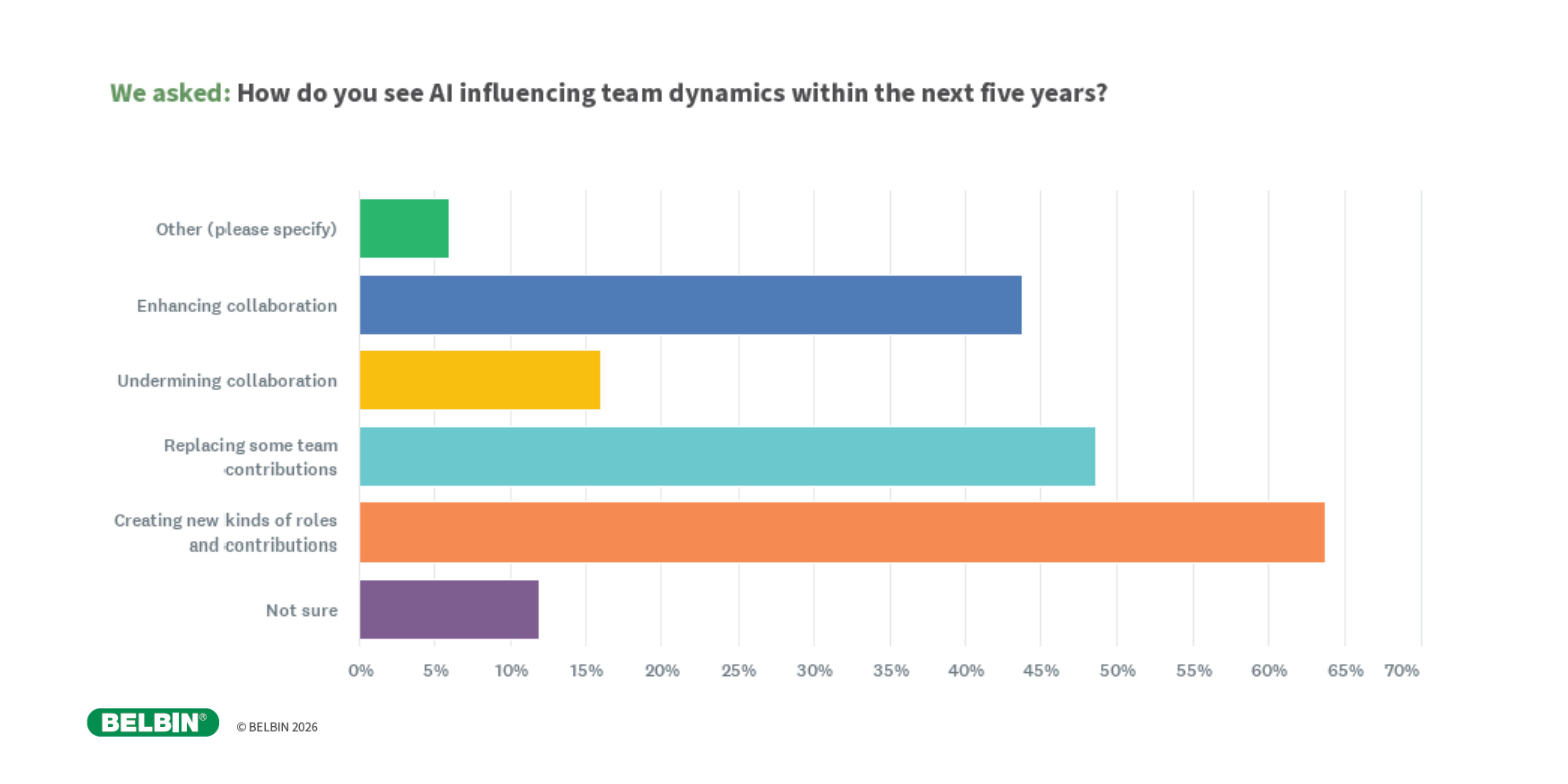
These findings suggest that employees do not see artificial intelligence solely as a tool for automation, but also as an opportunity to focus more on activities where people create the greatest value:
- solving complex problems
- creative thinking
- decision-making
- building relationships with clients and colleagues
- mentoring and developing others
New tools require greater clarity around team roles
As AI becomes part of everyday work, it is increasingly important to identify and understand who contributes what value to the team. In many organizations, employees are already using AI in different ways, with different levels of knowledge and different expectations regarding outcomes. This approach creates a risk of inconsistent standards, unclear responsibilities, and misunderstandings.
That is why, alongside the development of AI competencies, there is growing recognition of the need for greater clarity around team roles, responsibilities, and contributions.
Tools that help teams understand how individuals contribute to shared goals and where their natural strengths create the greatest value can be useful in addressing this challenge. Belbin Team Roles model can provide a framework for discussing which activities should remain primarily within the human domain, where AI can provide support, and how to ensure that different forms of contribution remain equally recognized and valued within the team.
Belbin is not focused solely on identifying individual strengths, but also on understanding how different team roles complement one another. The assessment is based on a combination of self-assessment and peer assessment, and the results can be used to support individual development, improve team communication and effectiveness, and gain a better understanding of how different team members can contribute to a shared goal.
What does this mean for HR and leaders?
Since AI raises questions that go beyond simply using technology, its implementation also needs to be viewed through the lens of how people collaborate, share responsibilities, and make decisions.
For HR professionals and leaders, this means that alongside developing digital competencies, equal attention will need to be given to strengthening teamwork and collaboration. Key priorities will include:
- setting clear expectations around the use of AI tools
- redefining roles and responsibilities where necessary
- developing a culture of openly questioning AI-generated results
- strengthening psychological safety and the quality of collaboration
- increasing awareness of the different ways individuals contribute to team success
AI can take over part of the workload, but the quality of collaboration will continue to depend on people. The ability to connect technological capabilities with human knowledge, experience, and ways of working together will be an important part of successfully implementing AI in teamwork.
Would you like to assess where your organization currently stands in terms of team effectiveness? Get in touch with us. We can help you gain a clearer picture of the current situation and define the direction for the further development of your people and teams.